
Induction annealing and stress relieving
Annealing is a heat treatment applied to relieve stress or improve microstructure. Induction suits it when the treatment is local, as in the weld seam of a tube, and when it must be fast, repeatable and in-line. Induction heating also covers hardening and tempering; see Metal Hardening . Fluxtrol’s experience concentrates on seam annealing and stress relieving of welded pipe, supported by research on strip annealing.
Seam annealing of welded tube and pipe
In welded tube and pipe production, the weld seam sometimes needs annealing to relieve stresses from welding or improve the microstructure. Induction heating is commonly used and is called seam annealing. At high production rates and for heavy-walled pipe, several seam annealers are placed in series.
Seam-annealing inductors are linear inductors, either vertical loop or split-and-return, operating at 1 or 3 kHz at power levels of hundreds of kilowatts. C-shaped soft magnetic materials, either laminations or soft magnetic composites, go over the central turn to concentrate heat on the weld seam. No controllers go on the return leg or legs, since a widely distributed return current minimizes heat generated there. Fluxtrol SMCs are used where the field is three-dimensional, such as the end zones, sometimes alongside laminations in the regular sections, and Fluxtrol LRM is designed for seam anneal coils among other types.
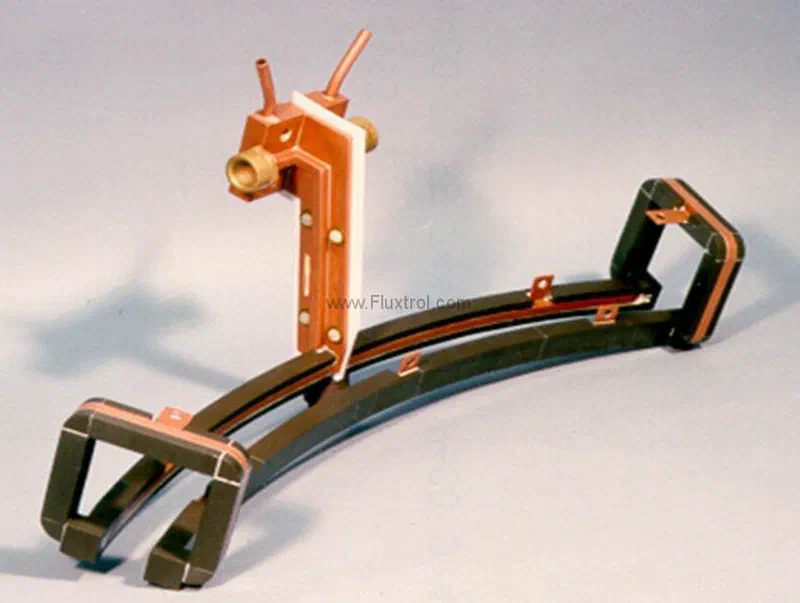
Case: design of a stress relieving coil and process
Fluxtrol’s free course includes a case story by Dr. Valentin Nemkov that shows how coil and process design decide results.
The problem. A pipe producer’s seam annealing system for spiral-welded, large-diameter pipe could not hit its production rate. Running at half speed still missed specification, because the heated zone was too narrow and the bottom of the seam stayed too cool. The machine had been built from seam annealing experience, not stress relieving requirements.
The conditions. Steel 1040, 12.7 mm wall, an existing 500 kW, 3 kHz power supply, limited space on the mill, a narrow window of 550 to 650 C, a 60 mm heat affected zone and a required heating time of 16 seconds.
The method. Fluxtrol simulated the existing process with Flux 2D, matched it to experiment, and then tried power profiling along the coil. That improved results but did not meet the specification. The final design:
- Made the central coil leg from two parallel conductors to widen the heated zone.
- Used power ramping and precise holding at maximum temperature.
- Used a Fluxtrol concentrator with a varying profile, full C-shaped during ramping and then shortened at the poles and removed once the maximum permitted temperature was reached.
The result. The customer built the coil to Fluxtrol’s suggestions, produced parts to specification at the desired rate, and the end user was satisfied. Take the full case story PDF from the induction heating course .
Annealing steel strip with induction
Fluxtrol also contributes to research on electrifying continuous annealing lines. Led by Alec Williamson at the Colorado School of Mines with U.S. Steel and Cleveland-Cliffs, the project explored whether rapid induction heating can replace gas-fired furnaces for advanced high-strength steels. Reported outcomes include enhanced retained austenite from rapid induction quench and partition cycles, improved ductility and refined microstructures in TRIP steels, and higher energy efficiency from transverse flux coils. See the technical article .
Local annealing with channel coils
Fluxtrol’s coil style notes list channel coils for local heating of parts such as fasteners, cartridges and rod ends, for annealing, tempering, brazing, curing and forge heating, with concentrators improving efficiency and temperature control.
Plan your annealing process
If you have a seam annealer or stress relieving process that is missing rate or temperature requirements, contact Fluxtrol . We can simulate the process, redesign the coil and recommend a flux controller.
Fluxtrol SMCs for annealing coils
Annealing and stress relieving cases
Design of a stress relieving coil and process
A customer's seam annealing machine for spiral-welded large-diameter pipe could not meet the required rate or specification because it had been built from seam annealing experience, not stress relieving needs. Fluxtrol simulated the process and redesigned the coil and power program.
- Steel 1040, 12.7 mm wall, 3 kHz, 500 kW, 550-650 C window, 60 mm heat affected zone, 16 s
- Central coil leg of two parallel conductors widened the heated zone
- Power ramping, precise holding at maximum temperature and a profiled Fluxtrol concentrator met the requirement
Induction annealing for advanced high-strength steel strip
Colorado School of Mines research with U.S. Steel, Cleveland-Cliffs and Fluxtrol examined rapid induction heating as an alternative to gas-fired furnaces in continuous annealing lines.
- Rapid induction quench and partition cycles retained more austenite
- Transverse flux coils showed higher energy efficiency