
Contactless heat for bonding, curing and joining
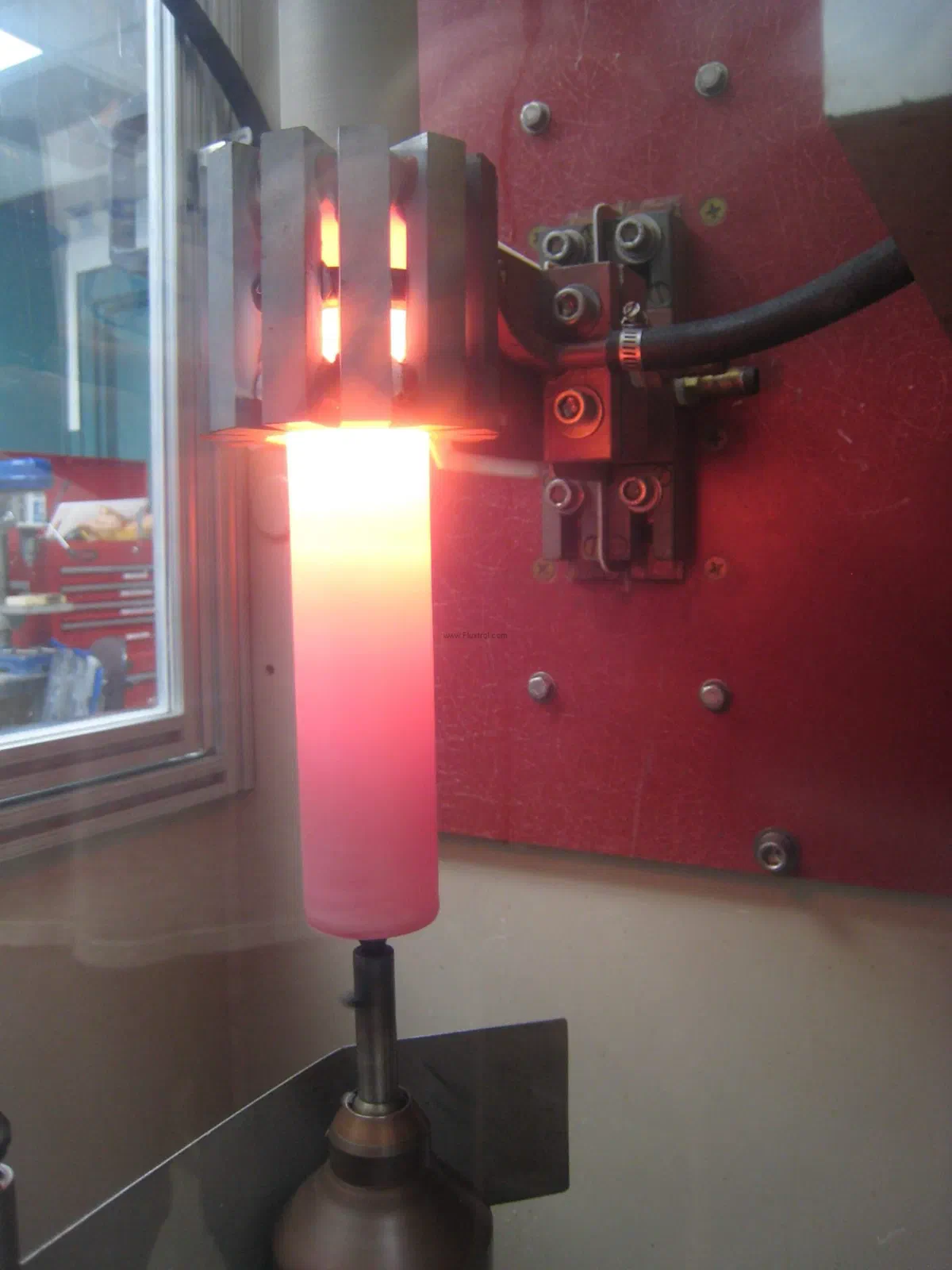
Induction bonding and curing systems heat a part, bond line or coating with an alternating magnetic field instead of a flame, oven or hot tool. Heat is generated inside the workpiece, so cycles can be fast and tightly localized, and nothing has to touch the part. That makes induction a natural fit for adhesive heating, curing and the joining of composites.
The difficulty is control. The magnetic field has to deliver the right amount of heat to the right place, and temperature at the bond line must be uniform enough to make a sound joint. That is the problem Fluxtrol’s coil design, simulation and magnetic flux control work addresses.
Why induction for bonding and adhesive heating
Compared with surface heating methods such as resistance, infrared or convection, induction can heat volumetrically. In Fluxtrol’s carbon fiber research, those other methods apply heat at the surface and need a significant time lag to reach temperature in depth without overheating the surface. Induction is also described as clean, fast and efficient, and it integrates well into mass production lines.
Typical advantages for bonding and curing:
- Contactless heating, with no tooling touching the joint
- Local heat where the field is applied
- Fast, repeatable cycles that suit automation
- Heating pattern that can be tuned with coil design and flux control
Welding carbon fiber thermoplastics: a documented case
The most developed bonding work in Fluxtrol’s library is induction welding of carbon fiber reinforced thermoplastics (CFRT). Induction can produce high-strength weld joints between CFRT parts, and it can also be used for tape placement, curing and consolidation, forming, repair and surface finishing of CFRT, with autoclave processing as the leading conventional method.
The challenge is the anisotropic electrical and thermal properties of CFRT. Eddy currents need closed loops through the carbon fibers, so fiber contact and orientation strongly affect where heat appears. Fluxtrol’s study used finite element simulation to design a coil for a lap joint between two CFRT plates, aiming for uniform temperature without exceeding 300 °C in the modeled case.
Findings from the paper:
- Heating intensity and distribution depend on coil design, frequency and material orientation.
- An optimal frequency exists for each coil design, balancing efficiency against thermal gradient in the weld.
- A two-sided vertical loop coil with a magnetic concentrator gave the best performance, reaching good joint uniformity in about 5 seconds in simulation.
- A one-sided hairpin coil gave uniform temperature after a 60 second hold, which matters when only one side of the part is accessible.
How magnetic flux control helps
Soft magnetic composites guide and concentrate the field. In the CFRT study, a Ferrotron 559H concentrator was included in the coil models. Placed around the coil, a concentrator raises coil efficiency and shapes the heat pattern, which is what a bond line needs. Fluxtrol’s simulation tools let engineers test coil styles, frequencies and concentrator layouts before building hardware.
Coating and adhesive applications
Induction heating is used across coating, hard facing, bonding and brazing in industry, and Fluxtrol’s SMCs have also been applied in liquid coating wiping, where magnetic fields blow excess molten coating material such as zinc from wire or strip. For adhesive heating and heat-shrink applications, Fluxtrol evaluates each case individually. Because outcomes depend on the part, adhesive and temperature window, we recommend a conversation before specifying a system.
Next steps
Fluxtrol’s R&D services and simulation team can model a bonding or curing process, design the coil and validate it with a prototype. Contact us to start.
Fluxtrol SMCs used in induction bonding research
Fluxtrol research on induction bonding and welding of composites
Coil design for welding carbon fiber thermoplastics
A Fluxtrol study used finite element simulation to design an induction coil that produces uniform temperature in a lap joint between two carbon fiber reinforced thermoplastic (CFRT) plates, examining the effects of frequency, material orientation and coil design.
- Targeted uniform joint temperature while not exceeding 300 °C
- Two-sided vertical loop coil with a concentrator performed best in the study
- Good uniformity reached in about 5 seconds, or less with added power
Modeling induction heat distribution in CFRT
This paper describes the anisotropic electrical and thermal properties of CFRT plate and uses them in electromagnetic and thermal simulation to predict heating behavior.
- Contactless, volumetric heating
- Anisotropy is the main design challenge
Characterization of CFRT for induction processing
Material characterization work supporting induction processing of carbon fiber reinforced thermoplastics.
- Supports accurate simulation inputs