
Rethinking induction forging and forming
Forging and forming shape many of the components used every day, from automotive drivetrains to industrial machinery and energy equipment. Induction heating has become a preferred way to prepare the workpiece because it delivers fast, controllable heat directly in the stock. The harder part is consistent, uniform heating, especially with complex geometries or multi-material components. Fluxtrol’s soft magnetic composite (SMC) flux controllers help engineers tailor heating patterns, improve efficiency and get more consistent results.
Why induction for forging?
Heating in the workpiece itself gives short heating cycles, precise temperature control and repeatability, which in forging translate into more consistent deformation. Uneven heating can cause defects such as cracking, incomplete forming or variations in material properties. Frequency choice follows size: Fluxtrol’s course material places low frequencies (50/60 Hz to 3 kHz) with melting, forging and deep heating, and middle frequencies (3 to 50 kHz) with small forging, among other uses.
Induction billet heating
Billet heating is among the most common forging applications. The billet is heated in a coil, then moved to the press or hammer. The central issue is uniformity between surface and core: heating the surface too hard risks oxidation or degradation, and under-heating the core leaves uneven deformation.
Where flux controllers fit depends on the coil:
- Long solenoids (length several times diameter) gain little from SMCs. Several coils bring the billet up to temperature distribution, and Faraday rings at the ends are the only controllers, shielding handling rolls and preventing cross-talk between coils.
- Rectangular stock benefits more as one dimension grows larger than the other. Transverse flux heating coils use soft magnetic materials, with laminations at low frequencies and SMCs at middle and higher frequencies and near the 3-D field at the ends of low-frequency coils.
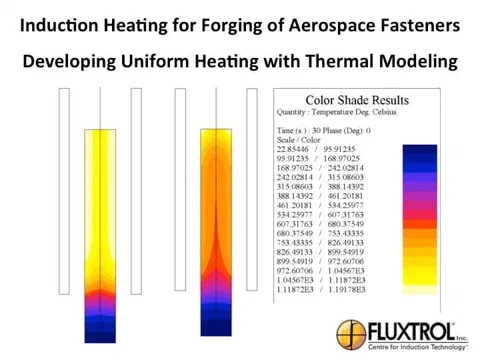
- Short coils and local heating gain the most, as below.
Bar end and local-area heating
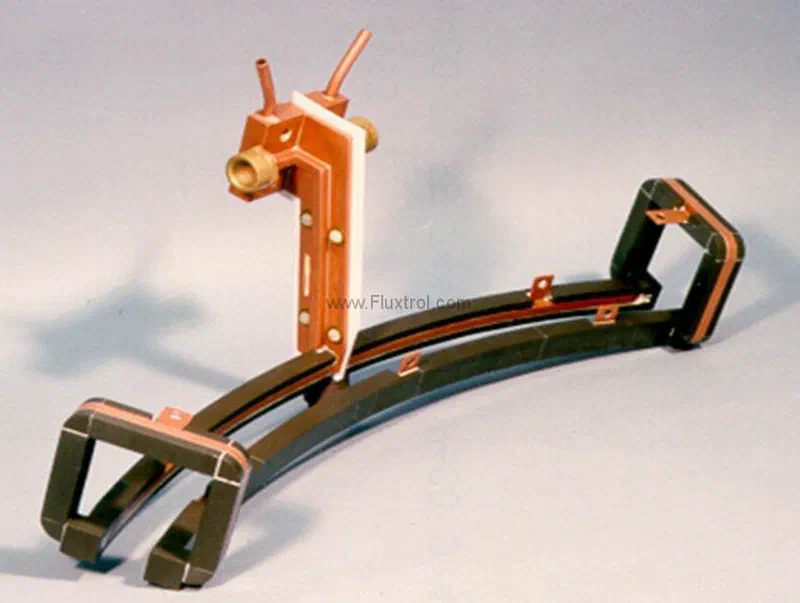
When only part of a workpiece is to be formed, local-area heating saves time and energy. It can be done statically with single-turn or multi-turn coils, or continuously with channel coils, whether single-turn for fasteners or multi-turn as in a bar end heater. The sharp gradient between heated and unheated zones and the need for control over zone length and position make flux control valuable. For single-turn channel coils, the ASM chapter reports that soft magnetic material reduces the power needed to heat the target area by 20 to 50%; SMCs are the material of choice because these coils usually run at 10 kHz or higher.
Multi-material billets and hot hydroforging
Lightweight design is pushing forging toward multi-material parts, and induction heating plays a central role in the research Fluxtrol has published with partners.
- Bimaterial hot forging. The concept studied is a steel tube press fit with a solid aluminum core (Al 7075 in a 1020 steel tube) and welded shut with steel end caps. Because the steel shell must be austenitic before the aluminum gets hot, fast induction heating was chosen. A coupled Flux2D and DANTE model predicted power needs and agreed very well with experiments, and cyclic on/off power let the aluminum melt without fracturing the steel case. The concept could lead to weight savings of up to 50% for products such as gears, valves and flanges.
- Hot hydroforging. Billets of this type are heated to 1000-1200 C, and the liquid or viscous core provides uniform hydrostatic pressure on the solid steel shell.
- Tailored forming. With IFUM at Leibniz University Hannover, joined steel-aluminum billets are formed so the joining zone is improved by thermomechanical processing. A near step-function temperature distribution is desirable, and induction heating is seen as the most promising method.
These studies show why electromagnetic simulation is part of designing a heating sequence. See Induction Heating Computer Simulation .
Cold-wall billet casting
Fluxtrol has also studied SMC inserts in cold-wall induction billet casters for titanium powder consolidation (melting rather than forging); see the UIE 2021 and IMAT 21 papers.
Improve your induction forging process
Contact Fluxtrol to review your forging or forming heating system, or visit Order SMC to buy flux controller material.
Fluxtrol SMCs for induction forging and forming coils
Forging and forming research with Fluxtrol
Heating sequences for steel/aluminum bimaterial billets
A hot forging concept uses a steel tube press fit with a solid aluminum core and welded shut with steel end caps. Induction heating had to bring the steel to austenite before the aluminum became hot enough to threaten the weld seams.
- Flux2D electromagnetic-thermal model coupled with DANTE
- Cyclic on/off power let the aluminum melt without fracturing the steel case
- Experiments agreed well with the modeling
Hot hydroforging of lightweight bimaterial gears and hollow products
Feasibility study of forming steel-shell billets with a liquid or viscous low-density core at 1000-1200 C, similar to conventional hot forging of steel.
- Uniform steel wall thickness observed after forming
- Voids in the aluminum core, which glass cores may avoid
Thermomechanical processing of friction-welded steel-aluminum billets
Tailored forming research with IFUM in which dissimilar materials are joined first, then formed; a near step-function temperature distribution in the billet is desirable and induction heating is viewed as the most promising method.
- Modeling of the forming process and prototype evaluation
- Joining zone properties assessed metallurgically
Role of thermal processing in tailored forming
Numerical and experimental analysis of induction heating of bi-material workpieces for a tailored-forming shaft.
- Joining zone treatment by thermal and thermomechanical processing