
Melting efficiency starts with the magnetic field
An induction melting furnace transfers power from a coil to the metal charge through a magnetic field. Anything that field does outside the charge, heating the frame, the crucible walls, the chamber or the coil itself, is lost power. Magnetic flux controllers made from Fluxtrol soft magnetic composites (SMCs) steer that field so more of it works on the melt.
This page covers where flux control applies in induction melting, what Fluxtrol’s cold crucible research found, and when it is worth looking at.
Three furnace types, three roles for flux control
Induction melting systems fall into three types: channel, crucible and cold crucible. Flux control plays a different role in each.
- Channel furnaces resemble a transformer and should always have a magnetic flux controller for better system efficiency. They run at low frequency to produce large volumes of metal, so laminations are the usual material.
- Crucible furnaces use a solenoid coil with a ceramic refractory or conductive crucible. Controllers mainly reduce external fields that heat the equipment structure or force a large footprint to meet exposure limits. Large low-frequency furnaces use shunts and Faraday rings.
- Cold crucible furnaces melt reactive metals, oxides, glasses and other materials in a segmented, water-cooled crucible, and have the largest efficiency headroom.
Cold crucible melting: documented results
Cold crucible furnaces are three-dimensional devices that are hard to model, and their electrical efficiency has traditionally been low, approximately 25-30% for metals. Fluxtrol studied them with simulation, laboratory mockups and industrial tests.
- In the mockup study, efficiency was only 25.4% without flux control and doubled with it. Using shunts, slit inserts and a concentrator ring brought efficiency close to the calculated maximum.
- For the same power in the load, flux control reduced the generator power 2 times and the capacitor battery size almost 3 times.
- With Retech Systems, flux controllers between crucible segments and around the coil raised the casting rate of 55 mm titanium alloy ingots by 31% at identical input power, with a marked improvement in surface finish.
What Retech says
Robert Haun, Director of New Product Development at Retech, reports that Fluxtrol’s concentrators and design assistance improved the performance of Retech’s cold crucible induction melting furnaces, and that the efficiency gains led to better melting ability and product quality, which matters for the advanced complex alloys reaching the market.
Shielding melting furnaces
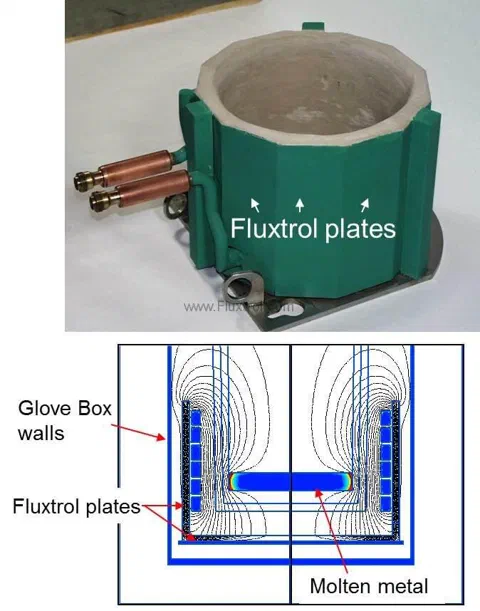
In furnaces operating in vacuum or a protective atmosphere, shielding improves efficiency, reduces coil current and eliminates losses in the chamber. That lets a designer reduce chamber dimensions or increase melting unit size in the same chamber. In one glove box example, a larger furnace would have delivered only 27% of its power to the charge. Composite shields around and under the coil raised that to 63%. In normal-atmosphere furnaces, shielding protects frame components and reduces fields at workplaces without impairing coil efficiency.
Stirring and electromagnetic processing
Fluxtrol’s EPM research notes that AC magnetic systems are used for material stirring, casting, pouring control and forming, and that SMCs suit these systems at medium and high frequencies because they can be machined into any geometry and work in 3D fields. Application-specific stirring guidance is not covered here; contact our engineers to discuss your process.
Next steps
Read the ASM Handbook chapter on flux controllers in melting , explore our melting expertise , or contact Fluxtrol . To buy materials, visit order SMCs .
Fluxtrol SMCs for induction melting
Cold crucible and melting research
Retech Systems: cold wall crucible for reactive metals
Retech Systems and Fluxtrol evaluated magnetic flux controllers on an open-bottom, ten-segment, water-cooled copper crucible casting 55 mm titanium alloy ingots. Controllers sat between the crucible segments and around the outside of the coil.
- 31% higher casting rate at identical 129 kW input
- Significantly improved ingot surface finish (qualitative)
- Crucible design was not yet optimized
Modeling and optimization of cold crucible furnaces
Fluxtrol used 3D simulation, lab mockups and industrial tests to study electromagnetic processes in cold crucible furnaces (CCFs). Shunts, slit inserts and a concentrator ring brought efficiency near the calculated maximum.
- Mockup efficiency of 25.4% was doubled
- Generator power reduced 2x and capacitor battery almost 3x for the same load power
Magnetic flux controllers in induction heating and melting
An ASM Handbook chapter covering flux controller use in channel, crucible and cold crucible melting systems.
- Laminations for large low-frequency channel furnaces
- Shunts and Faraday rings on large crucible furnaces
SMC inserts in cold wall billet casters
A simulation study of soft magnetic composite inserts and their effect on energy efficiency in cold wall billet casters.
- Powder titanium deposited onto a slowly pulled billet