
Magnetic flux control since 1981
Impeder Cores
Order SMCs
Distributors
1-800-224-5522
Intl +1-248-393-2000
Induction heating application
Reduce distortion and control heat patterns in induction hardening with magnetic flux concentrators.
Induction hardening is a surface-hardening process that heats a steel part’s selected areas above austenitizing temperature with an alternating magnetic field and then quenches them. Because heating is local and fast, distortion can be lower. Magnetic flux concentrators made from soft magnetic composites sharpen the heat pattern and extend coil life.
Induction hardening is the most common form of induction heat treating. A coil carrying alternating current induces eddy currents in a steel part, heating a selected surface layer above its austenitizing temperature, and a quench follows immediately to reach the required case depth and hardness. The main advantage over other heat treatment methods is the ability to heat quickly and selectively, only where the part needs modified properties. Fluxtrol’s published work describes the results as lower distortion, a more favorable residual stress distribution, better microstructure and significant energy savings.
The difficulty is the heat pattern. Specifications call for hardness in a bearing race or fillet and none in the adjacent snap-ring groove, so the coil must deliver power to the right place and nowhere else. Fluxtrol designs and simulates hardening inductors and supplies the soft magnetic composite (SMC) flux controllers that shape that pattern.
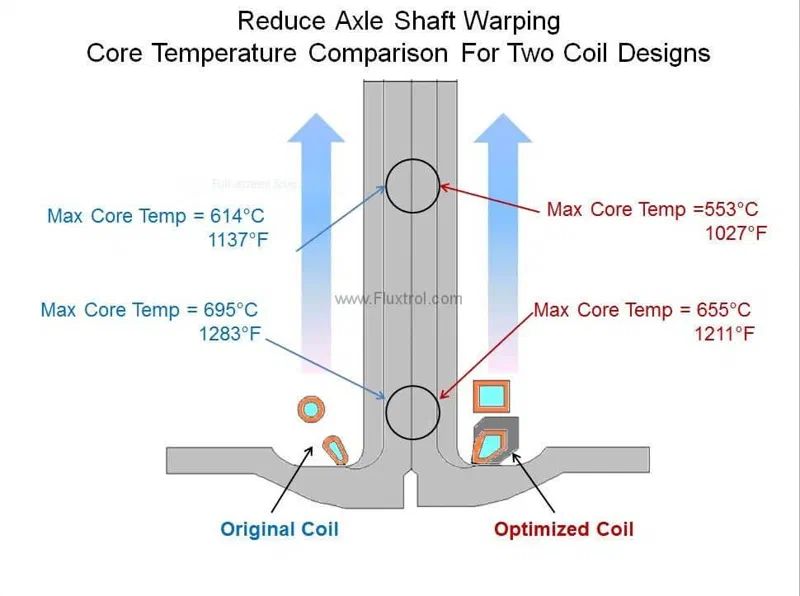
Distortion is a result of thermal gradients and phase transformation, so every part of the process contributes. Fluxtrol’s axle studies, which coupled electromagnetic, thermal, metallurgical and stress simulation, identify several levers:
A coil that puts the right power in the right place, with no more depth than required, is a distortion control tool.
Flux concentrators give the magnetic field a low reluctance path, so the field is concentrated around the coil instead of spreading through space. Nearly all of the current in the copper is driven onto the heat face, and the current in the part is concentrated under it. The practical results are:
The ASM Handbook chapter on inductor design concludes that a flux controller is a stronger way to control the heat pattern than profiling the copper, and that profiling the concentrator poles smooths transitions between zones. See Principles of Induction Heat Treating for the physics.
Every induction hardening process falls into one of two groups. In single-shot hardening the coil stays in position relative to the heated length (the part typically rotates), as with crankshaft journals and spindles. In scan hardening the coil moves along the part with a quench following it, as with axles. Methods compares them, and Inductor Styles covers machined integral quench (MIQ) coils, quench in place, and encircling versus non-encircling designs.
More are in the case studies and the Technical Library .
Hardening coils fail mainly in the copper. Each cycle heats the copper while power is on and cools it when power is off, and the resulting thermal cycling causes fatigue cracking, usually in nearly the same place on a consistently built inductor. The ASM chapter lists three ways to extend life: more cooling, lower local power density, or a different coil design. SMC concentrators help with the second, because they lower the coil current needed for a given power and so reduce copper temperature and busswork losses. In severe applications the flux controller can also limit life, typically through corrosion at elevated temperature, which is why Fluxtrol has published work on improving the corrosion resistance of SMCs for induction heat treating.
Fluxtrol uses simulation to test coil geometry, frequency, scan speed and concentrator shape before building tooling, and can couple electromagnetic and thermal results with metallurgical and stress analysis to look at distortion. The approach is described in Induction Heating Computer Simulation and in the technical library paper Virtual Prototyping of Induction Heat Treating .
Whether you are starting a new hardening process or fixing an existing one, contact Fluxtrol to discuss coil design, SMC selection and simulation. To buy flux controller material, visit Order SMC .
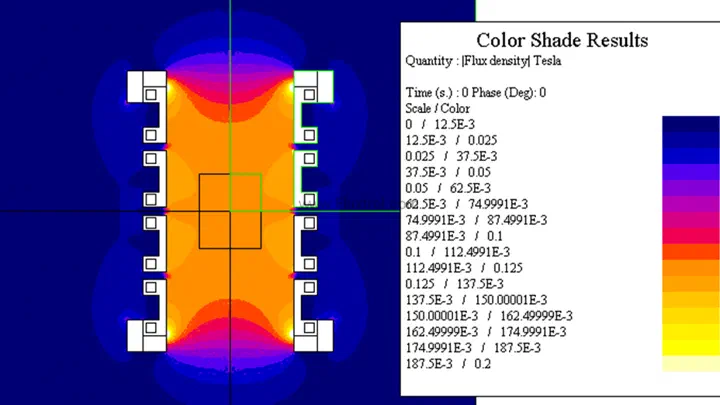
Understand induction heat treating: current flow, frequency and skin depth, proximity effect, coupling gap, coil copper profile and flux …
Learn more →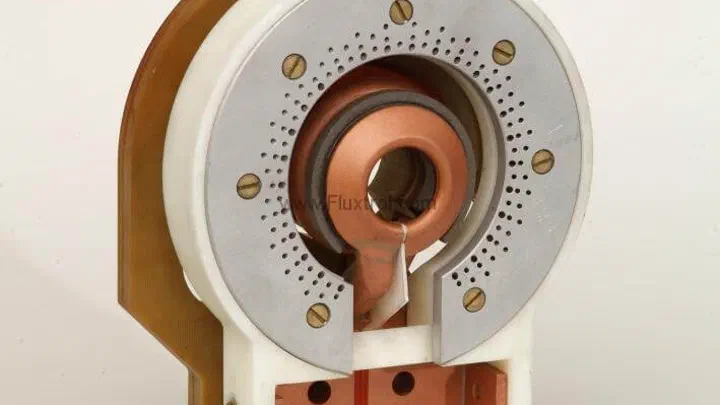
Compare single-shot and scan induction hardening, with crankshaft and axle examples, and learn how coil style, quench and flux controllers …
Learn more →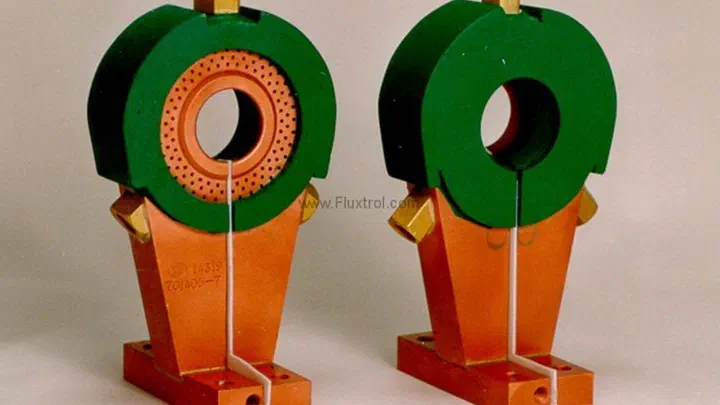
Compare induction hardening inductor styles: machined integral quench (MIQ), quench in place, encircling and non-encircling coils, and the …
Learn more →Talk with a Fluxtrol engineer about your coil, material or heat pattern challenge.