
Two ways to harden: single shot and scanning
All induction heat treating processes can be classified by whether the coil moves relative to the part during heating (excluding rotation). In single-shot hardening it does not; in scanning it does. Choosing between them depends on part geometry, heat treatment specification, material, production rate and the equipment available. The ASM Handbook chapter by Fluxtrol authors describes the choice as part of the first questions in inductor design: will the part run on an existing machine or does a new one have to be built.
Single-shot applications
In a single-shot installation the coil sits at the heated length and the pattern is heated at once. The part commonly rotates during heating and quenching to even out the pattern. Quench delivery gives three families:
- Machined integral quench (MIQ): quench is built into the coil, usually delivered through the copper and sometimes through the flux concentrator.
- Quenching in place: the quench ring is part of the coil assembly, but is not an active component of the induction circuit.
- Separate quenching: quench is a different station or position, useful when a delay for heat soaking is wanted.
Typical single-shot coil styles include encircling, encircling/non-encircling, linear and ID coils. The main role of soft magnetic materials here is controlling temperature distribution, particularly near the coil ends and at geometry changes. Lower coil current, and the energy and transformer savings that follow, is a secondary benefit.
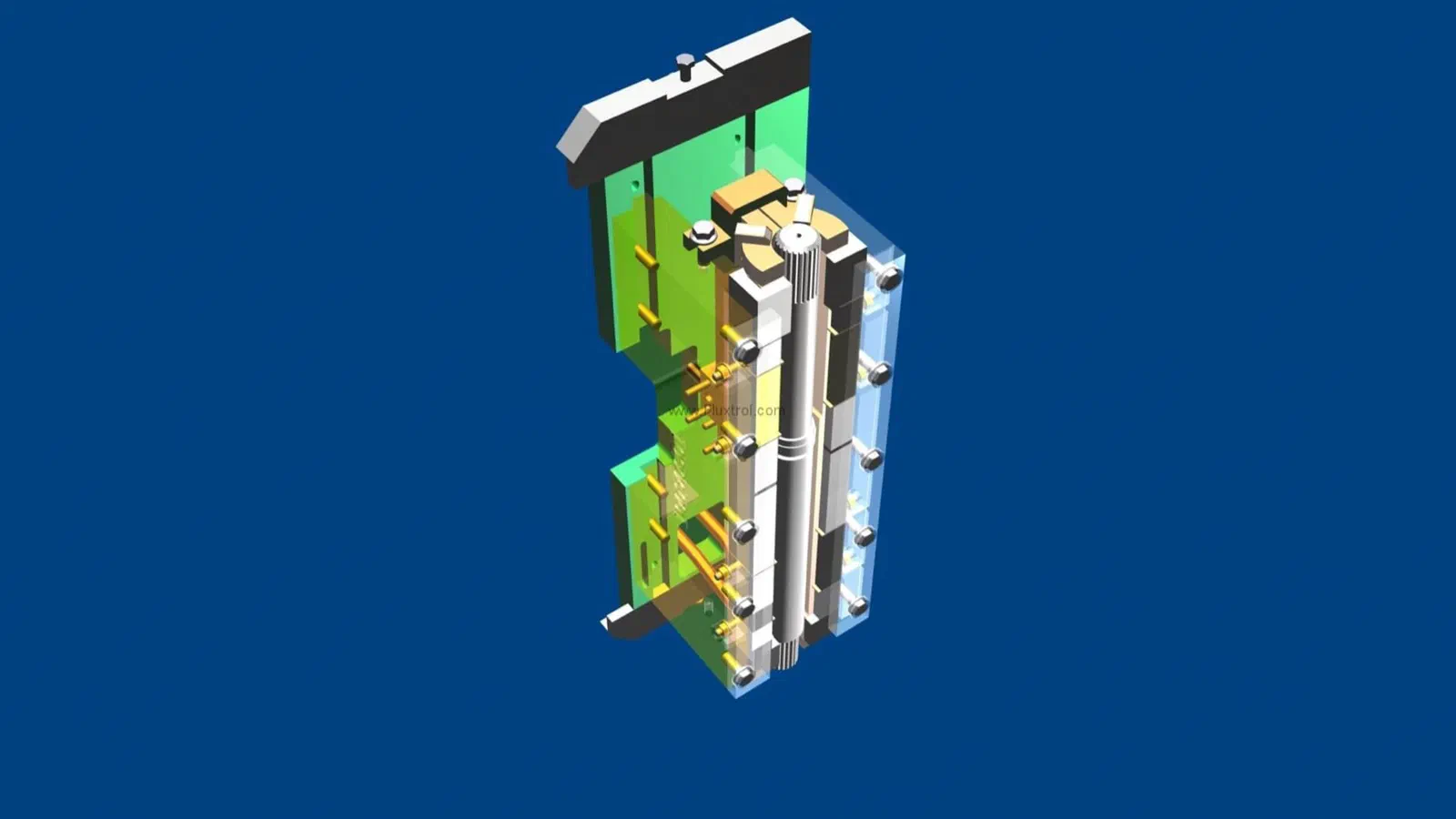
Example: crankshaft hardening
Crankshaft pins and journals were the first industrially induction hardened parts, in the early 1930s. Early clamshell coils with mechanical, hydraulic or pneumatic locking were followed by non-encircling U-shaped coils that rotate with the part. In a production study with a crankshaft manufacturer, laminations and copper keepers on a U-shaped coil were replaced with Fluxtrol A. The main failure mode had been copper cracking under the laminations. With the SMC, the concentrator could be longer on the same winding, coil current dropped for the same power, the fillet pattern was more uniform and hardening depth increased, and the coil lifetime rose 100%. Because SMC works in 3-D fields and can be machined right on the coil, the pattern could be fine-tuned during setup.
Scanning applications
In scan hardening, the coil moves along the part while a quench follows. Scan coils can be MIQ or quench in place; separate quench is less common. Common coil styles are encircling coils, short linear coils and channel coils. With encircling coils the main benefit of a flux controller is pattern control at the beginning and end of the part. Savings are smaller than for single-shot coils because stray heat before and after the coil still contributes to case depth, but where the fillet drives design, as in axle scanning, the ASM chapter cites energy savings between 15% and 50%.
The quench should be designed to impinge directly for at least 1.5 times the length of the coil heat face, with holes angled away from the coil in the direction of travel so water does not wash back into the inductor.
Example: axle scan hardening
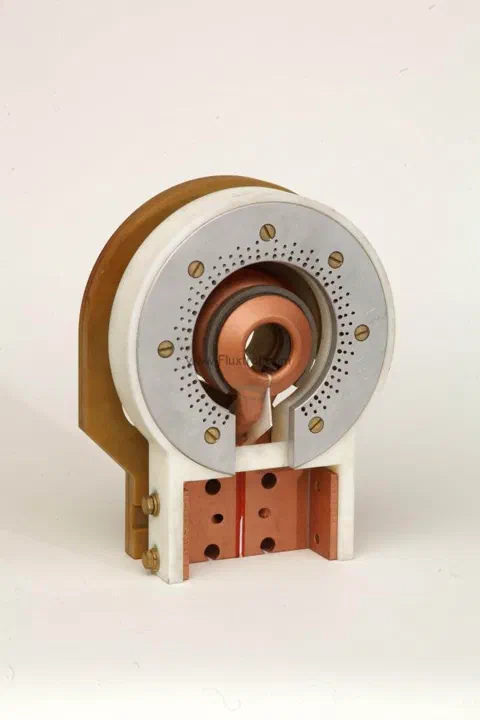
Axle shafts are scanned with single-turn or two-turn profiled coils and a trailing quench ring. Two-turn coils are preferred where possible for energy savings and higher production rates, but struggle with the fillet and the end-of-shaft run-out. In the Fluxtrol study of a 48 mm full-float axle (SAE 1541H):
- A standard two-turn coil could not heat the sharp fillet properly without overheating the shaft just above it.
- An optimized two-turn coil with Fluxtrol A on the lower loop spread heating farther up the shaft and tolerated variation in coupling gap.
- Scan speed rose about 15% at 1 kHz (limited by the 100 kW coil power) and over 35% at 3 kHz (limited by surface temperature).
- At 3 kHz the stronger proximity effect made the fillet easier to heat.
A related Fluxtrol case story describes a customer who could not make parts with a sharper fillet; a two-turn coil with a Fluxtrol A concentrator on the lower turn gave good fillet depth with the stem area below 1020 °C and a high scan rate. Long axles also raise distortion concerns, so Fluxtrol’s stress and distortion modeling is applied alongside coil design.
Choosing a method
| Consideration | Single shot | Scanning |
|---|---|---|
| Coil vs. part | Fixed relative position (part usually rotates) | Coil moves along the part |
| Typical parts | Crankshaft journals, spindles | Axle shafts, long shafts |
| Quench | MIQ, quench in place or separate | MIQ or quench in place; separate less common |
| Pattern tuning | Built into coil design | Also by power and scan speed |
Our engineers use simulation to compare both options for a given part. Contact Fluxtrol to discuss yours.
Fluxtrol SMCs for single-shot and scan coils
Single-shot and scanning in practice
Crankshaft hardening inductors
Crankshaft journals were the first industrially induction hardened parts. A production study replaced laminations and copper keepers with Fluxtrol A on a U-shaped rotational coil.
- Pattern more uniform, deeper in the fillet
- 100% increase in coil lifetime reported
- No change to the copper other than removing keepers
Axle scan hardening
Scan hardening of a 48 mm full-float axle compared a standard two-turn coil with a Fluxtrol A optimized design at 1 and 3 kHz.
- About 15% faster at 1 kHz, over 35% at 3 kHz
- Larger tolerance on coupling gap
Frequency control for axle scanning
A follow-on study examined what additional improvement is possible by changing frequency during the scan process.
- Builds on coil optimization at 1 and 3 kHz
Stress and distortion of a truck axle
Coupled simulation of an induction scan hardened full-float axle examines bowing, length growth and residual stress from heating and spray quenching.
- Bowing is the main concern above 1 m shaft length
- Quench severity changes residual stresses