
Induction coil manufacturing turns an engineered design into a water-cooled copper inductor that carries high current, delivers heat to the part and survives electromagnetic forces, thermal cycling and the shop environment. Fluxtrol builds coils from copper tubing, machined copper or both, and completes them with the structure, quench components and magnetic flux controllers the design calls for. Fabrication follows from coil design and engineering and is checked through the quality and integrity procedures before a coil ships.
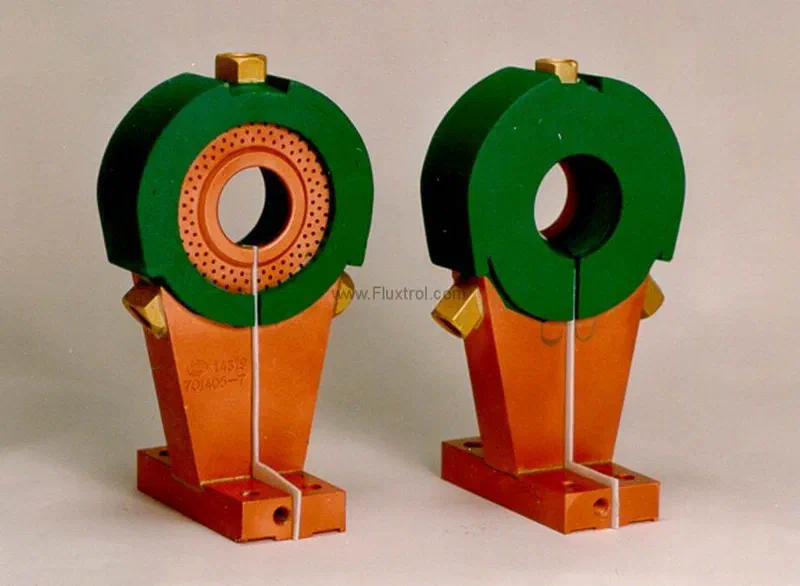
Two construction approaches
Early melting and mass-heating coils were copper tubing wrapped in multiple turns around a mandrel. The first heat treating coils, developed for crankshaft hardening in the 1930s, were machined instead, which reflects the different requirements of heat treating (ASM Handbook Volume 4C).
- Copper tubing coils. Tubing is formed around a mandrel and doubles as the cooling path. Rectangular tubing gives a flat heating face and is advantageous for SMC placement and adhesion.
- Machined copper coils. Detailed inductors are machined from electrolytic copper sheet, plate or round, with cooling passages integrated in the copper. Parts are fit, silver brazed and assembled.
- Combined designs. Coils can use tubing for some sections and machined copper for others.
Basic construction skills: tubing and brazing
Copper forms easily into complex shapes. In forming it work hardens, but heating to a dull red and quenching in water makes it easy to form again. A basic inductor can be built from readily available tubing wound on a forming mandrel. Depending on the power supply configuration, electrical connections may be brass pipe fittings (flare preferred over compression) or copper tabs soldered to the tube. The ASM chapter states electrical soft solder is sufficient at power levels of 10 kW or less.
Advanced machining and copper skills
Complex heat treating inductors usually need a classically trained machinist with the dexterity and patience for modelmaking, plus instruction in copper-specific cutting tools, speeds, feeds and coolant. The work involves many small parts of various materials that must be machined, formed, silver brazed and assembled. Inductors are usually built one at a time, often by a single machinist, in a shop with a milling machine, lathe, band saw, a ventilated brazing table with torches and an assembly bench.
Key fabrication points from the ASM chapter:
- Fit must be good enough to make cooling chambers watertight and electrical connections sound.
- Silver brazing needs enough torch heat to hold temperature through the copper mass, suitable flux and silver rod.
- The package should include a bill of material, component details and an assembly and inspection form.
Coil styles
Coil style follows the process. Fluxtrol sources describe the following, and notes call out ID, linear and hairpin styles in particular.
| Style | What the sources say |
|---|---|
| Single-shot and scanning | Coil fixed relative to the heated length versus moving relative to the part |
| Machined integral quench (MIQ) | Quench delivered through the coil copper, with separate pockets for cooling and quench |
| Encircling, encircling/nonencircling, linear | Different current paths in the coil and part for the same spindle-type geometry |
| ID coil | Heats inside diameters; shown with and without quench in Fluxtrol examples |
| Hairpin | Used for flat and non-flat surfaces, often with an SMC controller and robot scanning |
Video demonstrations of hairpin, internal diameter, pancake and earmuff coils are in the media gallery .
Structure, cooling and flux controllers
Low-frequency or high-power-density coils need a mechanical support structure, typically fiber-reinforced plastic components such as stud boards, retainer rings and mounting plates. Most heat treating inductors are water cooled, and passages must suit the power level with minimal flow restriction. Magnetic flux controllers, whether silicon steel laminations, ferrite or soft magnetic composites, are then attached by bonding or mechanically; see custom flux controllers .
Repair and maintenance
Coils are exposed to electromagnetic stress, heat, oily smoke, steam and grime. Regular cleaning with soap, water and a soft plastic brush, plus inspection, catches deterioration early. Cracks from cyclic fatigue, differential cooling or resistive braze joints are often silver brazed, but the ASM chapter calls such patches seldom permanent and advises replacing the coil at an appropriate life interval.
Start a coil project
Tell us the part, process and power supply and we will review fabrication options. Contact Fluxtrol to discuss a new or replacement coil.
Real-world results
Hairpin coil built with Fluxtrol A
A hairpin coil made from 1/2-inch rectangular copper tubing with Fluxtrol A on one section, machined, epoxy bonded and coated, then tested against simulation.
- Rectangular tubing gives a flat heating face
- Rectangular tubing also suits SMC placement and adhesion
Design and Fabrication of Inductors (ASM Handbook 4C)
The reference chapter on inductor construction skills, repair, flux controller attachment and integrity procedures.
- Basic and advanced construction skills
- Repair and maintenance practice