
Magnetic flux control since 1981
Impeder Cores
Order SMCs
Distributors
1-800-224-5522
Intl +1-248-393-2000
Soft magnetic composites
Soft magnetic composites (SMCs) are engineered materials that give magnetic flux an easy path in an induction system, so engineers can concentrate, shape and shield the field instead of letting it spread. Fluxtrol pioneered their use in induction heating and makes them in two families, matched to different coil geometries and production needs.
| Machinable | Formable | |
|---|---|---|
| Grades | Fluxtrol 100, A, 50, 25 and Ferrotron 559H | Alpha-form LF and MF |
| How made | Powder metallurgy compaction and heat treatment | Molded around the coil surface and cured in an oven |
| Best for | Precision-machined cores and complex geometries needing specific magnetic and mechanical properties | Irregular coil shapes where machining is impractical; quick, cost-effective installation |
Not sure which fits? Compare the grades below, browse all SMC products , or ask an engineer . Ready to buy? Order SMC materials .
| Property | Fluxtrol 100Machinable | Fluxtrol AMachinable | Fluxtrol 50Machinable | Ferrotron 559HMachinable | Alpha-form LFFormable | Alpha-form MFFormable |
|---|---|---|---|---|---|---|
| Density ±2% (g/cm³) | 6.8 | 6.7 | 6.2 | 5.9 | 4.1 | 4.0 |
| Operating frequency range (kHz) | Up to 50 | Up to 100 | Up to 500 | Up to 3000 | 1–80 | 10–1000 |
| Maximum permeability | 132 | 142 | 55 | 18 | 13 | 10 |
| Saturation flux density (T) | 1.6 | 1.5 | 1.4 | 1.2 | 1.0 | 0.9 |
| Temperature resistance (°C) | 225 long term / 300 short term | 250 long term / 300 short term | 250 long term / 300 short term | 250 long term / 300 short term | 225 long term / 300 short term | 225 long term / 300 short term |
| Thermal conductivity (W/cm·°C) | 0.28 | 0.10 | 0.084 | 0.055 | 0.02 | 0.02 |
Fluxtrol 25 (machinable, performance up to 500 kHz) and the Ferrotron 559H Original grade are covered on their own pages. Property values are typical; ask us for data sheets and application guidance.
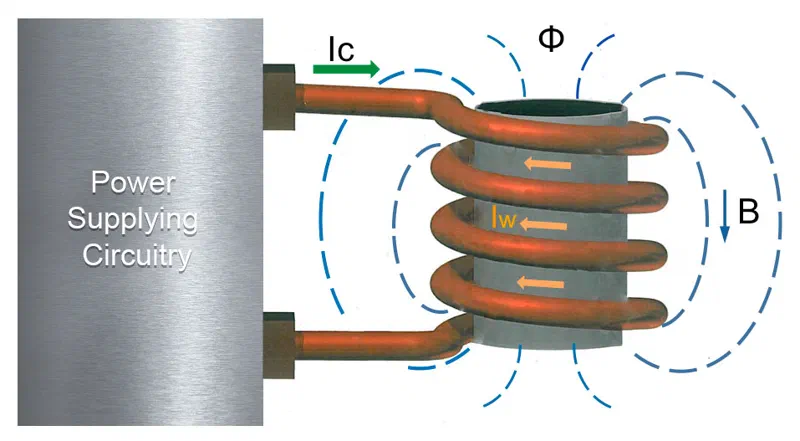
Induction heating is a contactless method, based on heating the bodies by means of energy absorption from the alternating magnetic field, generated by an induction heating coil lc (see Diagram A). There are two mechanisms of energy absorption: eddy current losses and hysteresis losses. Eddy currents Iw (see Diagram A) are being “induced” in conductive materials by a magnetic field that penetrates into the bodies. Eddy currents flow in closed loops inside the bodies and heat them due to the electrical resistance of their material.
Hysteresis is the lagging of the magnetization of a ferromagnetic material, such as iron, behind variations of the magnetizing field. When ferromagnetic materials are placed within a coil of wire carrying an electric current, the magnetizing field, or magnetic field strength H, caused by the current forces some or all of the atomic magnets in the material to align with the field. The net effect of this alignment is to increase the total magnetic field, or magnetic flux density B. The aligning process does not occur simultaneously or in step with the magnetizing field but lags behind it. (Britannica)
Hysteresis heating occurs only in magnetic materials. Hysteresis heating is caused by the internal “friction” of magnetic micro volumes (domains), which rotate following the orientation of the external magnetic field.
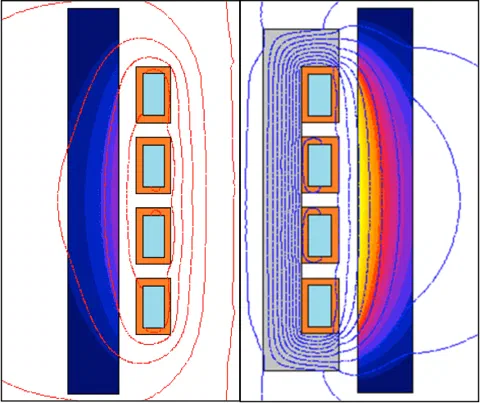
In solid materials, hysteresis losses are much lower than eddy current losses and often neglected in calculations. In particulate materials, they are a major or even only source of heating. In both cases, heat intensity is approximately proportional to magnetic flux value Φ squared. According to the laws of physics, magnetic flux flows along the closed path around the coil turns. Magnetic materials provide an easier way for magnetic flux to flow than air. By placing magnetic controllers in specific areas we can control the value and distribution of the magnetic flux density B. Depending upon its function (effects), a controller may be called a concentrator, diverter, shield, core, or impeder (in welding).
On many occasions, the controller can play several roles, such as concentrating field in one area and reducing in another. Due to a favorable combination of magnetic, thermal, electrical, and mechanical properties, Fluxtrol composites are excellent materials for different types of magnetic controllers.
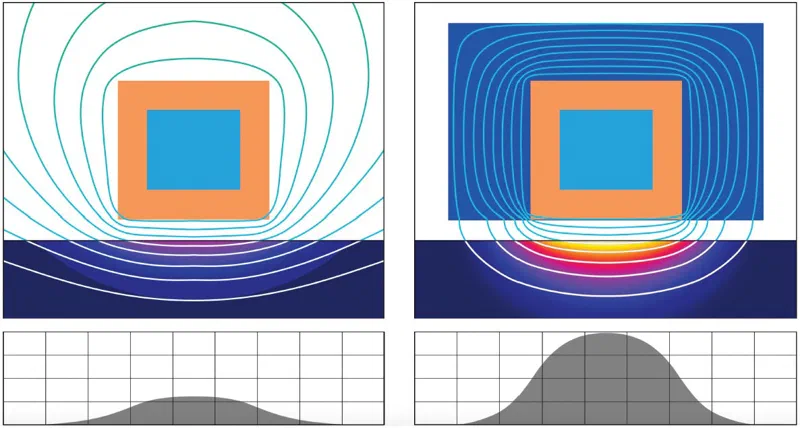
Application of C-shaped concentrators surges magnetic flux produced by the coil current and increases power generated in the part. In addition, the concentrator makes power distribution under the coil “face” narrower and closer to a rectangular shape. This results in better utilization of induced power.
Power distribution along the part surface, magnetic field lines concentration and power density color maps for a coil with and without concentrator.
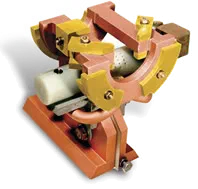
Magnetic controllers, locally placed on a coil for single-shot hardening of shaft, provide effective heat pattern control.
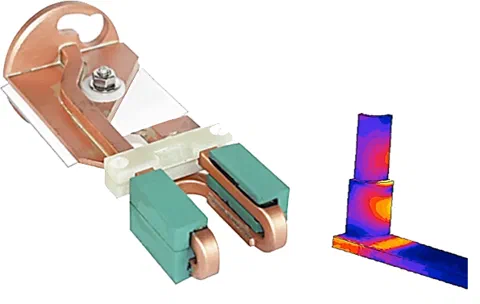
This horse-shoe coil was designed for brazing an output pipe to aluminum car heat exchanger. In addition to big improvement in coil efficiency, the magnetic controller precisely distribute power between three components of the joint guaranteeing high quality of brazing.
Magnetic shielding is required in several cases:
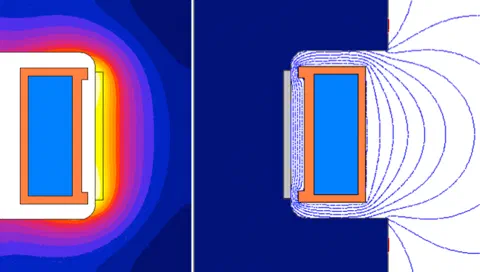
Magnetic flux of bare clamshell coil causes significant unintended heating of the crankshaft web.
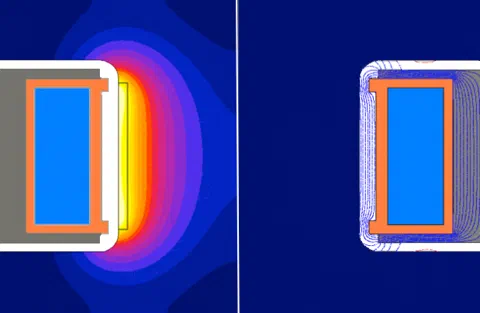
Fluxtrol composites are excellent materials for shielding when used alone or in combination with Faraday shields (conductive rings).
In melting furnaces working in a vacuum or protective atmosphere, shielding not only improves the furnace efficiency and reduces the coil current, but also eliminates losses in the chamber. It allows a designer to reduce the chamber dimensions or increase melting unit size for the same chamber.
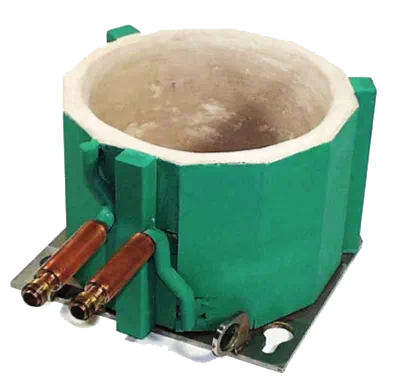
Ceramic-lined induction heating coil with Fluxtrol A shields (side and bottom) for melting radioactive materials in protective environment (glove box application).
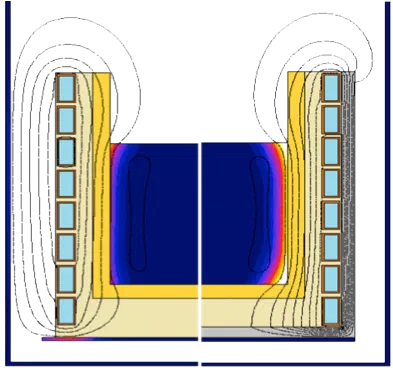
Magnetic flux line and power density distribution in a melting system without (left side) and with magnetic shields.
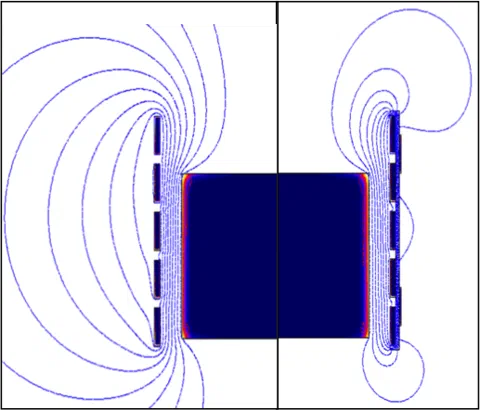
In melting furnaces working in a normal environment, magnetic shielding protects the frame components from unintended heating and strongly reduces the magnetic field on workplaces without impairing the coil efficiency.
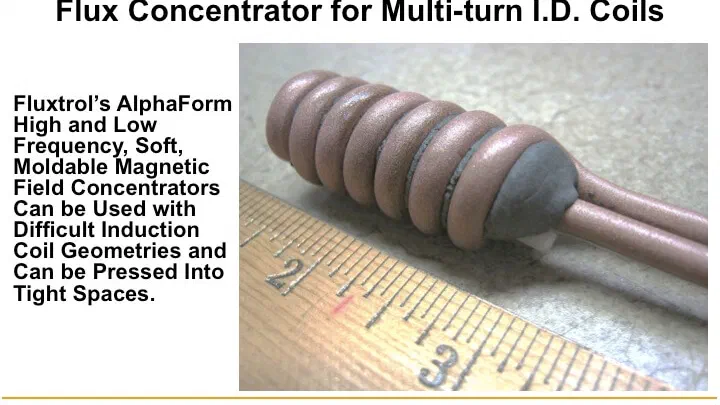
Compare Fluxtrol, Ferrotron and Alphaform soft magnetic composites by type, frequency, permeability and saturation to choose the right grade …
Learn more →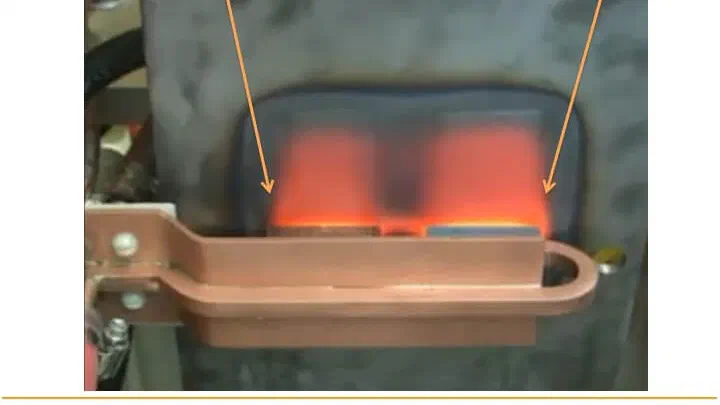
Soft magnetic composites improve coil efficiency, sharpen heat patterns, shield equipment from stray fields and extend into sensors and …
Learn more →
How to install Fluxtrol soft magnetic composites on an induction coil: machining, assembly, protection, maintenance and safety, in the order …
Learn more →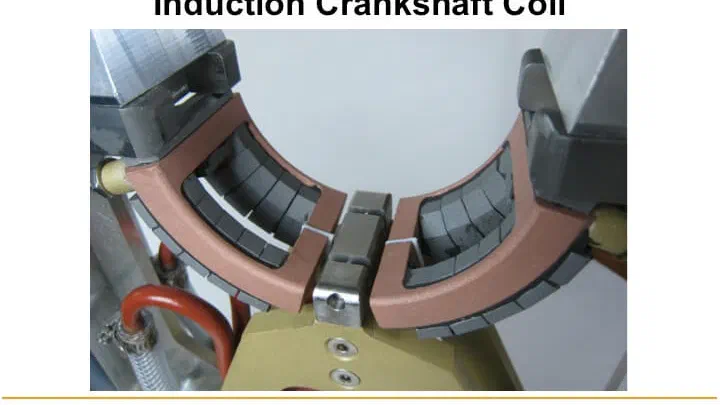
Compare ferrites, soft magnetic composites and electrical steel laminations for induction coils: frequency, saturation, 3D fields, …
Learn more →Talk with a Fluxtrol engineer about your coil, material or heat pattern challenge.