Soft magnetic composites

Machining Soft Magnetic Composites

Machinability between plastics and metals, so you can cut controllers of almost any geometry.

Fluxtrol soft magnetic composites are metal powder in a plastic binder, with machinability between plastics and metals. They can be turned, milled, drilled, ground and saw-cut, and water jet cuts flat parts. Carbide tools work best, CNC is recommended, and no cooling fluid is needed.

Fluxtrol materials are composites of metal powder and plastic binders, and their machinability falls between plastics and metals. Ferrotron 559H is closer to plastics, while Fluxtrol A and 100 are more like light metals, although more brittle. Different grades call for different technique to get the best results.

Material behavior to plan for

  • Strong in compression, with less strength in tension or bending loads. Design parts so that machining and assembly loads stay compressive where possible.
  • Anisotropic pressed grades. Orientation of the stock plate can matter in critical cases, and all Fluxtrol machinable materials are anisotropic to a degree.
  • Brittle to varying degrees. Fluxtrol 100 machines well when sharp tools and high spindle speeds are used.

Machining methods

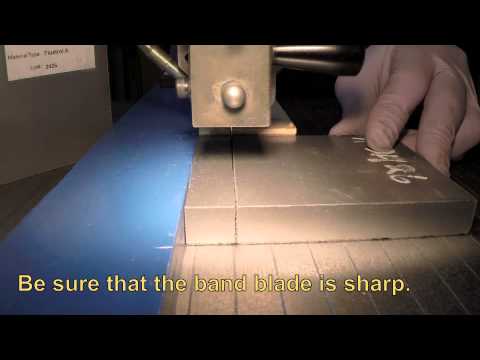
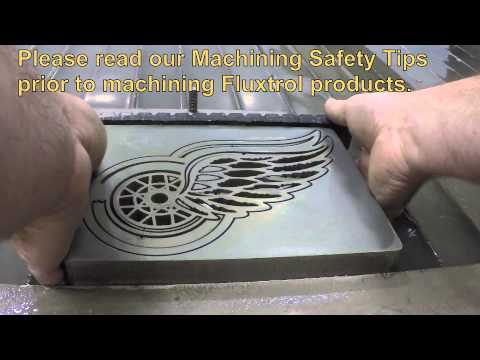
General machining practice applies for each operation: blade and band saw cutting, milling, turning, drilling and grinding. CNC machining is recommended. Water jet cutting is effective for 2D parts when the shape allows.

Practical guidance

  • Use sharp standard tools or coated carbide. Carbide is best, and high speed steel works well.
  • Use higher speed and slower feed than for soft steel.
  • Use multiple passes for thin-wall parts. With experience, wall thicknesses under 1 mm can be turned or milled.
  • Support drilled parts firmly, for example on a wooden or plastic block, to avoid chipping, and use pilot holes for large bores.
  • Cooling or lubricating fluids are not necessary.
  • Establish optimal regimes on sample material before producing multiple parts.
  • Brass or stainless steel inserts give the strongest threaded connections. See assembly for insert installation.

Machined surfaces carry a smeared layer that can conduct electricity and rust. Etching removes it, as described on the protection page .

Video demonstrations

Fluxtrol recorded machining demonstrations on each process.
Safety first

Chips are not hazardous, but friction sparks can ignite accumulated dust. Read Machining Safety & Fire Precautions before cutting.

Questions about a part?

Contact Fluxtrol for machining advice or to order material through the SMC order form .

Frequently asked questions

What tooling should I use to machine Fluxtrol?
Carbide tools work best, but high speed steel also works well. Sharp standard tools or coated carbide are recommended. Fluxtrol 100 has good machinability when sharp tools and high spindle speeds are used. Use higher speed and slower feed than for machining soft steel, and establish optimal regimes on samples first.
Can Fluxtrol be cut with a water jet?
Yes. Water jet cutting is an effective method for making 2D parts from Fluxtrol plates, and flat parts can be cut from disks or plates. Optimal cutting parameters are easily found by experiment. A water jet is not suited to shapes that need turning or milling.
Does the machining direction matter?
In some critical cases, yes, because the materials are anisotropic. Usually it is not a concern. Performance depends mainly on magnetic permeability, which sets the concentration effect, and thermal conductivity, which sets how fast heat leaves the concentrator toward the cooling channel. Fluxtrol publishes recommendations on orientation.
Can I recycle Fluxtrol chips?
No. Pressing chips will not give you valuable material that could be used for magnetic flux concentrators. Machining chips can be curls (typical of Ferrotron), small chips or powder, and they are not hazardous according to the material safety data sheets.
How do I make threaded holes in Fluxtrol?
Threads can be tapped directly in Fluxtrol or Ferrotron, but for higher strength and repeated use, install brass or stainless steel inserts. A small drop of epoxy secures the insert, which is especially recommended in Ferrotron 559H because of its low coefficient of friction.

Optimizing an induction process?

Talk with a Fluxtrol engineer about your coil, material or heat pattern challenge.